Monday, February 27, 2017

How Not To Run For Reelection

Donald Trump is running for president. Less than a month into his administration, he has already held a rally to begin the 2020 campaign, and he is accepting campaign contributions. His speech this week at the Conservative Political Action Conference, (CPAC), also found him, after 15 minutes of incoherent whining about the evils of the press, in campaign mode. The speech was full of boastful promises of all the wonderful things he would do if elected.

There are two problems with this that come immediately to mind. First, given that Trump is already being watched by the press and others for any concrete signs of conflicts of interest, soliciting donations this early only worsens the problem. But Trump’s speech also shows that he does not understand how a reelection campaign is different from an election campaign. Trump was able to get elected by making a series of promises, and by striking a pose as the champion of the little guy. Some of his promises were frightening, and his supporters would tell you that he wasn’t really going to do these terrible things. The wall, paid for by Mexico, to keep “bad hombres” out was an obvious fantasy, they might say, but it showed his concern about American jobs bleeding away to other countries. A total ban on Moslems entering the country was another obvious fantasy, they would tell you, but it showed he would be tough on terrorists. His supporters by and large had bought the story that Obamacare was the evil replacement for the Affordable Care Act, and Trump would replace it with something so much better.

When you run for reelection, however, you don’t get to run on just promises, and you don’t have supporters who can say you won’t really do what you have already done. You run for reelection based on what you have actually done, and how it has played out. Donald Trump is running for reelection at a time when he has accomplished remarkably little, and what he has accomplished has shown that the worst fears that his defenders tried to brush off are not just fantasies. On Tuesday, Trump will submit his first budget to Congress, but up to now he has sent no major legislation there, and there is no sign that he is ready to do so. Given the reported disarray within his cabinet, expectations for any coherence in the budget document are low. Meanwhile, Trump arrived in the White House thinking he could govern entirely by Executive Order, and he immediately tried to institute the Moslem ban. He was shocked to discover that our nation has a system that places checks on his power, and the ban was thrown out in court. The promised new executive order to reinstate the ban has yet to emerge, probably because there is simply no legal way to do it, but Trump keeps trying. He continues to brag about how he is going to get that wall built, but people are starting to understand that it will be the American people who will pay for it through higher taxes. Trump has also ramped up deportations of illegal immigrants. In this case, there has been some great coverage of the human cost of this policy. It becomes much harder to campaign on being tough on illegals when the press is reporting about hard working parents who fear that their children will be orphaned one day because their parents will be stolen from them. Stories of overreach by immigration officials, such as beloved children’s author Mem Fox promising that she will never again visit the United States, have also made the Moslem ban harder to campaign on. Trump is still trying to campaign on his promise to repeal and replace Obamacare, but he has left Congress flailing away at how to do this, while he has failed to provide any direction or guidance. The town hall protests have brought out many stories in the press about how repealing the Affordable Care Act would harm real people, including many who voted for Trump. Trump his also tried to take credit for the performance of the economy since he took office, but it was immediately pointed out that this shows instead the success of Obama’s economic management. There has been no time yet for anything Trump might have done to have any effect on the economy, and even that budget won’t make a difference for another year.

Altogether, Trump has very little in the way of accomplishments to campaign on at this point, and what he has done has been shown to be harmful to real people who are telling their stories. So the empty promises and the 2020 campaign continue.Trump ended his CPAC speech with these words:

There is no dream too large, no task too great. We are Americans, and the future belongs to us — the future belongs to all of you. And America is coming about, it's, and it's coming back and it's roaring and you can hear it. It's going to be bigger and better. It is going to be, it is going to be. Remember. And it's roaring. It's going to be bigger and better and stronger than ever before.

I was chilled, thinking of this:

Wednesday, February 22, 2017

Government By Punk Rock

This is a political blog, and this is a political post, I promise. I will be talking about the here and now, but I need to start in the late 1970s, talking about punk rock. Bear with me.

So, as I said, we begin in the late 1970s. Popular music had burst at the seams with creativity in the previous decade, and the range of ideas that popular music could express similarly exploded. But, in the 1970s, the record companies began to realize that this music could make serious money, and they turned major label music into a product. There were still artists and groups who wanted to say something real, but it became harder for such artists to get signed. Albums became more and more crafted: where the Beatles had made 19 albums in 6 years, now 6 albums in 19 years would be closer to the mark for someone like Michael Jackson. The music sounded like it was three years in the making as well. Pop music became dominated by artifice, by emotional poses rather than the emotion itself. An awful lot of bad music came out of this, as well as some extraordinary art that I personally needed many years to learn to appreciate on its own terms. But the immediate sincerity of the music of the 1960s got lost along the way. Punk rock emerged into this setting as the antidote to all this. It was deliberately uncrafted. It was a badge of honor amongst groups like the Sex Pistols that they could barely sing or play their instruments. The Circle Jerks rammed the point home with a cover of The Gilligan’s Island Theme that was more of a deconstruction. Punk rock was supposed to be a revolution, the overthrow of corporate rock. The problem was that the revolution was doomed to fail. Any group that stayed together too long began to learn to play and sing; they then had the choice to either pretend they still had no talent, or to keep their honesty by revealing what they had learned. Both the Clash and XTC were groups that started as punks, but no longer were by the release of their third albums. Neither group ever lost the fire that initially fueled them, but now they had become artists.

Politically, our situation now reminds me of the early days of punk rock. The current wave of the politicization of fear began when the 9/11 terrorists provided George W Bush with the opportunity to become a national hero by showing his toughness in a war with Iraq. But Bush was still a product of corporate politics, representing a Republican establishment that wanted to govern their way, but wanted to govern. The Republican brand of punk rock started with two related developments during the Obama presidency: the decision by Mitch McConnell to refuse to pass anything Obama proposed; and the rise of the Tea Party movement. These developments had in common a determination to overthrow the current order. Tax cuts, which had been a Bush triumph for his wealthy backers, became instead a means of destroying the government and its “bloated” programs. A right wing media environment grew up to support these ideas. It gave a voice to the fears and hatreds of supporters who had grown weary of the coded messaging of establishment Republicans. The genius of Donald Trump was to recognize that blatant racism and xenophobia would be a badge of authenticity to this audience. The outrageous and ugly things he said during the 2016 campaign were proof to this crowd of his genuineness. He was punk.

Just as the punks had to prove their authenticity with their lack of musical ability, Trump began to build his cabinet with a group of people whose complete lack of knowledge of how to govern was a badge of honor. But now there is a problem. A Republican Party and a Tea Party movement built on overthrowing the government now controls it. The forces arrayed to destroy our government must now govern, and we see that there was never a plan for what to do if this day ever arrived. They know what they were against, but they have no idea what they are for. The time has come for the punks to learn to play their instruments.

Not all of the punk rockers ever did become musicians. Many lived in a haze of drugs that prevented their talents from emerging, and also killed many of them. Similarly, we have started to see scandals claiming the political lives of some of the political punks. Andrew Puzder and Michael Flynn are gone, and their replacements are establishment Republicans. While I am sure that some hardline Republicans will never be cured of the ideological psychosis promoted by the likes of Fox News and Breitbart, there will be others who will actually learn to govern. To quote another pop culture reference, they will learn that with great power comes great responsibility.

The Republicans have already begun to sort themselves into factions, one that truly wants to figure out what to do with this prize they have won, and another that wants to retain their punk authenticity at all costs. Which faction comes to dominate the next four years, if either one does dominate, will be determined by how closely the rest of us continue to watch them. The scandals are our best hope of weeding out the bad apples, which means we must continue to protest, and we must also continue to support honest media sources. Most important of all, we must build a team that knows how to govern for when our turn to do so comes around again. That means winning local elections, and building from there. When our turn to govern at the national level comes again, we must be ready to show the American people the benefits of knowing how to do it. We must learn to play our own instruments.

There has to be a song to close this one, and this seemed like a good choice:

Monday, February 13, 2017

Strategy and Tactics

From a bad start, the fight is going much better than I feared. The bad start was the election. By now, I hope everyone can see that corporatist Democrat Hillary Clinton, with all of her considerable warts, would have been far better than what we have now. We would not be arguing about the Moslem ban, or wondering how deeply the people who now govern us are in bed with Vladimir Putin, and that’s just for starters. Less appreciated however is the importance of the makeup of Congress. Democratic majorities in both the House and especially the Senate were within our grasp, but we could not make it happen. In practical terms, this has meant that Donald Trump has been able to nominate and get confirmed pretty much whoever he wants. The majority party also gets the majorities and chairmanships of all committees, meaning it will be that much harder to get Congress to investigate anything.

So what is going well? The Women’s March was a spectacular success in terms of getting a huge number of new people engaged. More important, people have stayed engaged. The airport protests against the Moslem ban were certainly not on the scale of the Women’s March, but they were great to see. Even more encouraging has been the organizing of the protests at town halls around the country. The Tea Party candidates swept into power within the Republican Party over the last eight years, but now we are reminding them that they are out of excuses. It’s time for them to show their voters what happens when they have to actually govern, and that may be their greatest weakness.

Having said that, there are two things we must understand and act on if we are to successfully resist Trump, and both were illustrated by events this week. The first is that there is a vast difference between the two major parties, as most clearly seen by the roll call on the Betsy DeVos confirmation. One more Democrat in the Senate, no matter who it was, would have meant her defeat. That show of strength might have also led to the defeat of Jeff Sessions. The second thing we saw this week was that we can and must find common ground where we can with people who voted for Trump, even if they say now that they don’t regret that decision. Maggie Magerko is the head of Lumber 84, and she has no regrets about her vote for Donald Trump. But her company created a commercial that Fox aired in edited form during the Super Bowl that is a powerful endorsement of the value of the sacrifices immigrants to this country make to get here. By all accounts, Ms Magerko herself was very involved in the message of the ad, and fought Fox to try to air the full version. Instead, you can see it online here. Magerko says she wanted to show the “big beautiful door” that Trump spoke of during the campaign, meaning that we would welcome legal immigrants to our country. But Magerko and her company created a powerful testament to the humanity of the people who seek to come here, and that should be the starting point of any conversation about immigration. This is someone who has the capacity to tell the difference between a refugee fleeing ISIS and someone who is actually dangerous.

So where do we go from here? The protests need to continue, and so do the phone calls to Senators and Representatives. There is and will be an overwhelming amount of mischief to keep track of, and we will miss some, but we must not allow fatigue to set in. There are many of us, and some can take up the slack when others flag. We do not have to do this alone. But the power of this will be limited, especially in 2017. That is because we are a population over all that has a history of not voting. To come into our power fully, we must vote in November of this year. Odd year elections are sparsely attended, so we can put candidates in office just by showing up. That is how the Tea Party was built, and we can do it too. More importantly, this election actually makes a great deal of difference. We can give governing experience to a large group of people who can become our farm team from which to field candidates for higher offices down the road. But we can also change the composition of state houses nationwide in time for the redistricting in 2020, and that is how we can defeat gerrymandering. Also, voting this year moves us from the category of unlikely to likely voters. That makes a huge difference to pollsters. Suddenly, the protests and the letters and phone calls gain great power.

As voters, and especially as new voters, we need to recognize that the two major parties are different. The right wing that has now given us Donald Trump has long promoted voter apathy through the myth that the parties are the same. I return here to the Devos roll call. Every Democrat opposed this nomination. Evan Bayh is as bad as Democrats get. He is a corporatist, and he is at least somewhat to the right of Hillary Clinton. He comes from Indiana, a state that thought having Mike Pence for governor was a pretty good idea. So we were not going to elect a strong progressive to the Senate in Indiana. But it was thought that Bayh had a good chance to win back his old Senate seat there. Progressives did not vote for him, however, and his Republican opponent won. I’m using Bayh as an example, but if he had won, Devos would not have been confirmed. If three Democrats like Bayh had won, the progressive caucus in the Senate would not have grown, but Bernie Sanders and Elizabeth Warren might be heading committees in a Democrat-controlled Senate. In the fight against Trumpism, we must understand that even conservative Democrats are our allies. More, we can reason with them, show them our strength, and get them to work for and with us, far more easily than we can sway Republicans.

We can also find common ground with Trump voters. They voted for a truly ugly human being, but that does not mean they are just as ugly. Maggie Magerko can understand the human side of the immigration debate. Your most right wing friends, if you did not delete them all on Facebook, can be engaged on the issues. Keep the parties and how you voted out of it, and just ask them how we should go about telling the difference between a dangerous immigrant and the guy who runs the falafel truck. Ask them how they would screen immigrants from the countries Trump excluded from his ban. Ask them how they would design a better health care system, and how they would pay for it. Ask them about jobs and even guns. And then, as they answer, keep yourself out of the conversation, and just listen like crazy. You might hear some good ideas. You will almost certainly remember why you were friends in the first place. And most of all, you will find things we can work on together.

Today’s song:

Monday, February 6, 2017

The New Normal

On Wednesday night, I set about the work of finding out about Neil Gorsuch. I had done some of this the night before, but now everyone would have posted their articles, and I would find what I was looking for, or so I thought. You see, my earliest memories of the Supreme Court are the phrase, “the Cogswell defeat”, although I really only began to pay serious attention during the Reagan presidency. But I am used to articles about Republican appointees portraying them as dangerous extremists who are well outside the mainstream. In particular, the Justice who Gorsuch is closest to in terms of ideology is Antonin Scalia, and I remember Scalia being described that way when he was nominated. But the articles I kept finding about Gorsuch duly noted his ideological leanings, but they emphasized how eminently qualified he is, and how hard he would be to defeat on his merits.

In general, I have seen the mainstream media grow a spine since the election, so I was puzzled. This was not a case of false equivalency, and it certainly was not prompted by any fear of a tweetstorm by Trump, so what was going on? How could someone who I know is so dangerous be written about in such a blasé manner? Then it hit me. In reporting about Gorsuch this way, Gorsuch is being presented as well within the mainstream because the stream has changed course. Back when Scalia was being confirmed things were different. Some statements that probably would have led to Scalia’s defeat in his confirmation hearings include: taking the position that corporations could not be restricted as to campaign contributions without restricting their freedom of speech; or arguing that one could refuse to obey federal law regarding your employees if you objected on your personal religious grounds, without regards to the religious views of said employees; or advocating that racism no longer existed, and therefore it was no longer necessary for the Justice Department to monitor election laws in states with the worst records of discrimination. Gorsuch, however, can take all of these positions in his hearings, because they are all now matters of settled law. Scalia and his allies on the Court won, and these are now mainstream ideas. When it comes to the Supreme Court, this is the new normal.

When you realize this, you also realize both how Trump became president and why this is so dangerous. Nixon began to make the scapegoating of minorities acceptable, although in veiled language, and he started the “war on drugs”. Reagan planted the idea that tax cuts for the wealthy were the best way to create middle class jobs, even though it was a mix of strong unions and safety net programs that had fueled the phenomenal economic growth in the 1960s. George W Bush created the surveillance state that we have today, and created the political climate that made Obama unwilling to try to dismantle it, and he also made torture an option for our military. All of these and more represent the foundation that Donald Trump has to build on, and all of these were outrageous ideas in their day. Now we have before us the threat that Islamophobia will become a driver of our foreign policy. We face the possibility that abortions and gay marriages could become illegal again. And we see every day the grab for more and more presidential power. Over the next four years, all of this and more could become the new normal, the standard by which our next president and Supreme Court will be judged.

At least until the 2018 elections, the best we can hope for as progressives is to prevent as much erosion as possible. We must recognize that corporatist Democrats are and should be our allies in this. We must do everything we can to insure that the Democrats, any Democrats, win both houses of Congress in 2018. Even if the Democrats had won just the Senate in 2016, we would not be talking now about the nuclear option for Gorsuch’s confirmation, and the cabinet confirmations would have gone very differently. The election of someone like Evan Bayh in Indiana would have brought us that much closer to the majority we needed to prevent Rex Tillerson from becoming Secretary of State, for example. Now we have the much more difficult job of finding a handful of Republicans to join us in preventing the new normal of 2020 from being a world we don’t want to live in. We must accept and elect allies wherever we can find them, and save the battle for the soul of the Democratic Party for a time when we have prevented Trumpism from becoming the new normal.

Today’s song:

Monday, January 30, 2017

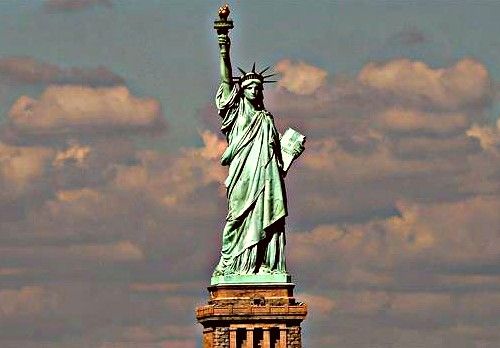
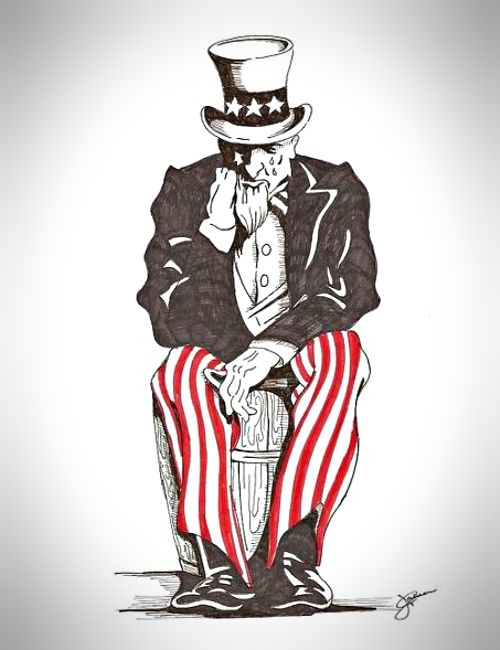
Lady Liberty Weeps

I was going to write about something else this week, but the combination of the initial plans for the Mexico wall and especially the ban on immigration from selected Moslem countries wiped away my other concerns for the moment. I am sure my readers have found plenty of articles to read on both of these topics. But I don’t want to focus on the legality of these measures, or the strategic or diplomatic implications, or the fact that each measure is bad for our country in its own way. All of that is true, but when it comes to immigration, it’s personal for me. To explain why, I want to tell you a story. It may not seem relevant at first, but I will get to that.

I am the grandson of Jewish immigrants to the United States. The only story I know at all well is that of my mother’s father. He came to the United States through Ellis Island as an 11 year old boy in 1911. He made the journey alone, sustained by the dream of being reunited with his older brothers who had preceded him here. He particularly was eager to be reunited with his favorite brother Harry. He and his family were fleeing the pogroms in eastern Europe, so I seriously doubt that his papers were in order, making it unlikely that he could have made it through the screening procedures that were already in place under President Obama. But, in 1911, he was allowed into the country. He grew up to be a gentle and loving man. We never discussed it, but I think he was always grateful to the country that gave him and his family refuge in those dark days. I never heard that he had any interest in relocating to Israel after 1948. He had made a good life here by then. He had learned a trade, in the days when bookbinding was done painstakingly by hand. Years later, when he had been long retired, he rebound a set of Encyclopedia Britanicas that my parents had had for many years. Ironically, the set was from 1911, the year my grandfather came to America.

Now suppose my grandfather had been trying to get to America as someone like Donald Trump took office. He would have been taken off the boat in Europe, and told he was no longer allowed to make the trip. If his brother Harry found out somehow what had happened and came to Europe to try to find him, he might not have been able to return to the United States. All of this would have been justified by a president who believed that notorious anti-Semitic propaganda, such as the Protocols of the Elders of Zion and the Rothschild banking conspiracy were real, and this theoretical president would have had a Steve Bannon figure at his side encouraging this belief. (For the sake of historical accuracy, the Protocols did not have much influence in the United States until they were promoted by Henry Ford in the 1920s, but you get the idea.)

You can tell me if you want to that the Jews and the Moslems in the modern Middle East are enemies, but these are human beings seeking refuge, just like my grandfather. Some of them have actually helped our country fight against terrorism, and it is now no longer safe for them to live in their country of origin as a result. They all have their stories, just like my grandfather, and their hopes and dreams are here. The Mexicans who seek to come here have received less attention this week, but they too are seeking refuge from poverty and crime, not bringing it with them. Donald Trump has obviously never needed to seek refuge from anyone, and he is emotionally incapable of imagining what that would be like. They say all politics is personal, and this certainly is for me.

Woody Guthrie understood that immigration policy affects real people with real lives, so his song Deportee is perfect here:

Monday, January 23, 2017

A Show of Strength

I want to thank the people who put together the Women’s Marches across the country yesterday. The period from November 9 to January 20 is a very small window to put something like this together, which makes the turnout yesterday all the more extraordinary. I want also to thank everyone who attended; I was not able to physically join you, but I was and am with you in spirit.

The pictures and reports of yesterday’s march, especially the one in Washington DC, took me back fifty years, to my childhood. Media reports yesterday noted that this was not the largest demonstration on record; that was the 1969 march against the Vietnam War. I went to that one as a nine year old boy, with my father and brothers. As happened yesterday, there were differing estimates of the size of the crowd, but it was announced from the stage that we were one million strong. The Vietnam War did not end that year or the next or the next, so we did not end it that day. Likewise, I have already seen articles which I agree with, pointing out that yesterday’s march will not in and of itself stop the agenda of Trump and the Republicans in Congress. But that does not mean that the Women’s March was not important. It was even more important than that demonstration I attended in 1969.

The election of Donald Trump on November 9 was a violation for those of us who opposed him. We were promised a Clinton presidency by all of the pundits and pollsters going in, but it was worse than that. Trump was and is the worst human being ever to win the office of President. He boasted of sexually assaulting women, mocked the disabled, and generally promoted hatred, division, and even violence on his way to victory. A popular majority of almost three million votes was not enough to keep him out. On election night, I and so many others were in shock over the results, and we were not encouraged as the new administration with its venal and unqualified cabinet took shape. Overall, we were feeling demoralized and isolated. So the cause of resisting all of this may not have been directly advanced yesterday, but it was an essential show of strength. Sure, Donald Trump and his friends in Congress know now that we are not going away, and they can not control us. But more importantly, we now have a powerful reminder that we are far from alone. I remember from 1969 what an amazing feeling it is to be part of something this big, and we needed that even more this year than we did then.

The question now, of course, is how do we translate our power into meaningful action? I hope the organizers of yesterday’s demonstrations took advantage of modern technology. If so, they now have a huge list of contacts who can receive information and calls to action. They can spread reliable information about what is going on in Washington, and generally counteract the continuing flood of distortions and outright falsehoods in the media. They can serve as gatekeepers, screening out bad information generated from both the right and the left. They can, of course, organize future demonstrations, which, with more time to put them together, should be even bigger than the ones yesterday.

But most of all, I hope they can get everyone who attended or wanted to attend to vote. That is our true power, and too many of us stayed home November 9. The ability to organize an event like the one yesterday can be translated into efforts to counteract voter suppression by helping those who need it to get their IDs in order, and arranging transportation to the polls. Where there are fees to obtain IDs, fundraising can be done. Time is a key here, because the 2017 elections are important. We will be choosing the first wave of officials who will determine what the 2020 redistricting looks like, so this is how we counter gerrymandering. Put another way, this is how we go about seating a more progressive House of Representatives to work with our next president. These off year elections also give us the best chance to seat progressives in local positions. We can build a farm team of people with experience governing for the bigger races in the future, but we have to start small and build up. This is something the Tea Party realized and began working on many years ago, but the Green Party never did. The Tea Party also understood that their best path to power was within the Republican Party. If they had tried to build a third party instead, they would have split the right wing vote as they became more powerful, giving up important races to the Democrats. We saw our power yesterday. It is enough to reform the Democratic Party and begin notching some victories. But we must go from showing and sharing our strength to putting it to use.

I want to share this in closing. It is not the slickest or most polished music video, but it seems to me to be the most appropriate:

Monday, January 16, 2017

A Cynic’s Call to Action

This past week, Cory Booker got raked over the coals by progressives for opposing a measure that would supposedly have allowed the government and citizens to save money by importing medicines from Canada. Booker was one of twelve Democrats who voted against the measure, and someone created a meme showing how much each of them received in donations from the pharmaceutical industry. Booker was singled out among this group because he is the only one who is considered to be a presidential hopeful in 2020. No one thought to ask, but if Cory Booker was a pariah to progressives for opposing this measure, does that mean Ted Cruz is a now a progressive hero for voting for it? Of course not. Which means it is time to talk about how to channel political cynicism to get as much of what we want as possible under the actual conditions in our country now.

First, understand that the Klobuchar/ Sanders amendment that Booker voted against and Cruz supported was never going to have any real effect, nor was it supposed to. It was pure symbolism. Mike Enzi, the Republican senator from Wyoming who heads the Budget Committee, would have gained the discretion to pass a bill to import drugs from Canada as a means of lowering costs to consumers, by reallocating funds approved for his committee. It’s every bit as convoluted as it sounds, and Enzi signaled with his no vote that he never would have used this power. Booker came up with the lame excuse that he opposed the measure over concerns about whether medicines from Canada were safe. Maybe he just thought that he could not explain to his constituents that he wanted to hold out for a measure that would actually do something. Considering some of the blaring headlines I saw on this vote, that makes sense to me.

It is time and past time to stop demanding it all from our politicians. Over the next four years, we will learn how much we have lost in the 2016 election. The election of Donald Trump and a Republican majority in the Senate means that Citizens United is with us for another thirty years at least. Trump will appoint justices in the mold of Antonin Scalia, and the Senate only needs a simple majority to get them approved. Filling Scalia’s seat will restore the 5-4 right wing majority, and Trump might get the chance to replace both Ruth Bader Ginsburg and Stephen Breyer as well. This also means there is no chance of restoring the Voting Rights Act. If you want to talk about constitutional amendments, look up the history of the Equal Rights Amendment and how it was defeated. So that means that someone like Cory Booker or Hillary Clinton has to take dirty money for their campaigns, or risk being outspent into oblivion by their Republican opponent. They can not count on the minority vote, because voter suppression tactics like those used in the 2016 election will go unchallenged by this Court. Booker in particular must take donations from the pharmaceutical industry. Booker is from New Jersey, as I am, and pharmaceuticals are our major industry. Bristol Meyers Squibb and Johnson & Johnson have their corporate headquarters here, and many other big pharma companies have a major presence in the state as well. So does that mean Booker is influenced by big pharma? Probably, but the better question is would we be better off if his Senate seat fell to a Republican? I hope everyone can tell by now that there are vast differences between the corporate Democrats and the insanity that is today’s Republican Party. If not, the next four years should be very instructive. For starters, we can not hope for any meaningful check on Trump’s conflicts of interest until and unless the Democrats win a majority in either the House or the Senate. That would give them all of the Committee chairmanships, which are necessary to start any meaningful investigation. In the Senate, a majority would also give the Democrats the power to oppose at least the most extreme Trump choices for the Supreme Court.

All of this means that we can not afford the luxury of ideological purity, especially not over the next four years. If Trump is to be opposed, we can not undermine someone like Cory Booker for taking corporate donations, when the alternative is a second Trump or Pence term. By extension, we are that much further away from universal healthcare, but our present concern is to save as much of the Affordable Care Act as we can, and hope the next Democratic president and Congress can improve it. Likewise, we can not hope to see a $15 minimum wage over the next four years; instead, we may be fighting just to keep a minimum wage at all. Our first task must be to attack the cancer of gerrymandering, and that means voting in large numbers in the local elections in 2017. The governors and state legislators we elect now will control the redistricting process in 2020, so we vote this year to improve the chances of seating more progressives in the House then.