Showing posts with label Immigration. Show all posts

Monday, August 7, 2017

Wandering

I usually try to keep up with the news all week, and try to organize my thoughts around a single topic for these posts. This week, however, I am going to take off from two items, and wander in several directions, to see where I wind up. I hope you enjoy the ride.

Generally speaking, the jobs report is released on the first Friday of every month. A positive report, such as we had this week, is an occasion for a sitting president and his allies to crow about how well they are doing, and Donald Trump is not one to pass on such an opportunity. The opposition has the task of trying to punch holes in the report, to explain why a positive report is really not so positive after all. In fact, all of the jobs reports since Trump took office, taken as a whole, present a pretty solid case that the economy is doing well. So I propose that we stop trying to find negatives in each report, and instead ask a simple question: what action or actions Trump has taken can explain the strength of the economy? Put another way, what has he done to deserve any credit for this? Because the simplest explanation is that the strong economy is the direct result of the continuation of Obama policies that Trump has been unable to eliminate or change yet. Most significantly, the federal government is still operating under President Obama’s last budget. Beyond that, we have Trump’s brainless executive order that two regulations must be eliminated each time one new one is created. This is largely political theater, since the laws Congress passes mandate that the executive branch must come up with regulations to enforce these laws. With that in mind, it can not be so easy to simply do away with a regulation, and doing so could be challenged on constitutional grounds. In any case, I have not heard of any specific regulation Trump has eliminated that has had any economic impact.

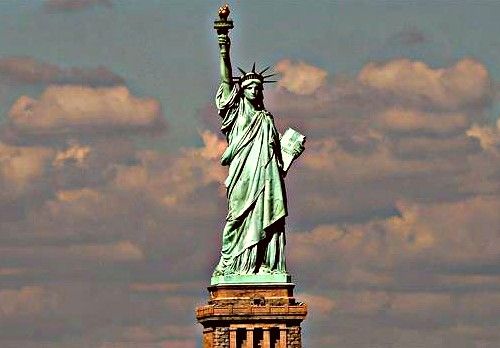
So, if Trump has not contributed to our economy through deregulation, as he would like us to think, what has he done? That brings me to the second event from this week that I wanted to talk about. Trump’s greatest impact so far has been on immigration. His directives regarding immigration enforcement have created an atmosphere of fear for both legal and illegal immigrants in this country. The threat of deportation has had a chilling effect on industries such as agriculture that are highly dependent on immigrant labor. The jobs impacted by this are ones that most native-born Americans refuse to do. Yet Trump continues to blather on about how he is keeping illegal immigrants from taking jobs away from Americans. His announcement of a new green card policy this week is deliciously ironic. He seeks to limit green cards to those entering this country who speak English well and have demonstrable job skills. Put another way, he wants to only let in those who actually will compete with native-born Americans for jobs. I wish CNN’s Jim Acosta, in his now infamous exchange with White House spokesman Stephen Miller, had not bothered arguing about the history of the Statue of Liberty, and had pursued this instead.

Acosta also had another line of questioning open two him that could have been very powerful. He could have asked Miller if he thought Acosta’s family should be in the United States. Jim Acosta’s father came to the US as a refugee from Fidel Castro’s brand of communism. Jim Acosta, in his choice of journalism as a career, represents perfectly the special American freedoms his father was seeking when he came here. It might not have been considered “journalistic” to talk about immigration policy in such a personal way, but this is one of the most personal issues we face, and I wish someone would say so in a highly public forum.

I work as a customer service representative. It is part of my job to talk to whoever comes up on the call list, and that includes people whose English is not the best, to say the least. These people are still our customers, and we must treat them accordingly. On the other hand, we are evaluated in large part by the volume of calls we take, and calls where we have to use an interpreter really slow us down. So you might think that I would be in favor of limiting green cards to those who speak English well. But I remember where I came from. Just this week, a coworker was venting about customers who don’t seem to learn English despite how long they may have been in this country. I reminded him of the Jewish heritage that he and I share. Did he have a relative who arrived here speaking only Yiddish, as I do? It turns out that my coworker had a grandfather who lived in the United States for 60 years and never learned English. That was possible because immigrants often live in communities where most neighbors share their heritage, and they work and shop in businesses that serve those communities. These communities are largely self-sustaining, but they also represent unique pockets of economic activity that Trump wants to get rid of. Go into any bodega today, and you will see products on the shelves from both Goya and Kelloggs. Those products represent American jobs.

Immigration is also a vital part of American culture. The melding of cultures to achieve something wonderful and new can be clearly heard in the song Bei Mir Bist Du Schoen. The title phrase is Yiddish, but the song is unmistakably jazz. Klezmer musicians arrived here as Jewish immigrants, and heard jazz for the first time. It influenced their music to the extent that any klezmer you hear nowadays includes this jazz influence, but it was a two way street. That is how jazz legends like Bennie Goodman and Artie Shaw made the clarinet a jazz instrument. I can think of no better way to celebrate the melding of cultures in our country than a video of Bei Mir Bist Du Schoen set in New York City’s subways:

Monday, February 27, 2017

How Not To Run For Reelection

Donald Trump is running for president. Less than a month into his administration, he has already held a rally to begin the 2020 campaign, and he is accepting campaign contributions. His speech this week at the Conservative Political Action Conference, (CPAC), also found him, after 15 minutes of incoherent whining about the evils of the press, in campaign mode. The speech was full of boastful promises of all the wonderful things he would do if elected.

There are two problems with this that come immediately to mind. First, given that Trump is already being watched by the press and others for any concrete signs of conflicts of interest, soliciting donations this early only worsens the problem. But Trump’s speech also shows that he does not understand how a reelection campaign is different from an election campaign. Trump was able to get elected by making a series of promises, and by striking a pose as the champion of the little guy. Some of his promises were frightening, and his supporters would tell you that he wasn’t really going to do these terrible things. The wall, paid for by Mexico, to keep “bad hombres” out was an obvious fantasy, they might say, but it showed his concern about American jobs bleeding away to other countries. A total ban on Moslems entering the country was another obvious fantasy, they would tell you, but it showed he would be tough on terrorists. His supporters by and large had bought the story that Obamacare was the evil replacement for the Affordable Care Act, and Trump would replace it with something so much better.

When you run for reelection, however, you don’t get to run on just promises, and you don’t have supporters who can say you won’t really do what you have already done. You run for reelection based on what you have actually done, and how it has played out. Donald Trump is running for reelection at a time when he has accomplished remarkably little, and what he has accomplished has shown that the worst fears that his defenders tried to brush off are not just fantasies. On Tuesday, Trump will submit his first budget to Congress, but up to now he has sent no major legislation there, and there is no sign that he is ready to do so. Given the reported disarray within his cabinet, expectations for any coherence in the budget document are low. Meanwhile, Trump arrived in the White House thinking he could govern entirely by Executive Order, and he immediately tried to institute the Moslem ban. He was shocked to discover that our nation has a system that places checks on his power, and the ban was thrown out in court. The promised new executive order to reinstate the ban has yet to emerge, probably because there is simply no legal way to do it, but Trump keeps trying. He continues to brag about how he is going to get that wall built, but people are starting to understand that it will be the American people who will pay for it through higher taxes. Trump has also ramped up deportations of illegal immigrants. In this case, there has been some great coverage of the human cost of this policy. It becomes much harder to campaign on being tough on illegals when the press is reporting about hard working parents who fear that their children will be orphaned one day because their parents will be stolen from them. Stories of overreach by immigration officials, such as beloved children’s author Mem Fox promising that she will never again visit the United States, have also made the Moslem ban harder to campaign on. Trump is still trying to campaign on his promise to repeal and replace Obamacare, but he has left Congress flailing away at how to do this, while he has failed to provide any direction or guidance. The town hall protests have brought out many stories in the press about how repealing the Affordable Care Act would harm real people, including many who voted for Trump. Trump his also tried to take credit for the performance of the economy since he took office, but it was immediately pointed out that this shows instead the success of Obama’s economic management. There has been no time yet for anything Trump might have done to have any effect on the economy, and even that budget won’t make a difference for another year.

Altogether, Trump has very little in the way of accomplishments to campaign on at this point, and what he has done has been shown to be harmful to real people who are telling their stories. So the empty promises and the 2020 campaign continue.Trump ended his CPAC speech with these words:

There is no dream too large, no task too great. We are Americans, and the future belongs to us — the future belongs to all of you. And America is coming about, it's, and it's coming back and it's roaring and you can hear it. It's going to be bigger and better. It is going to be, it is going to be. Remember. And it's roaring. It's going to be bigger and better and stronger than ever before.

I was chilled, thinking of this:

Monday, January 30, 2017

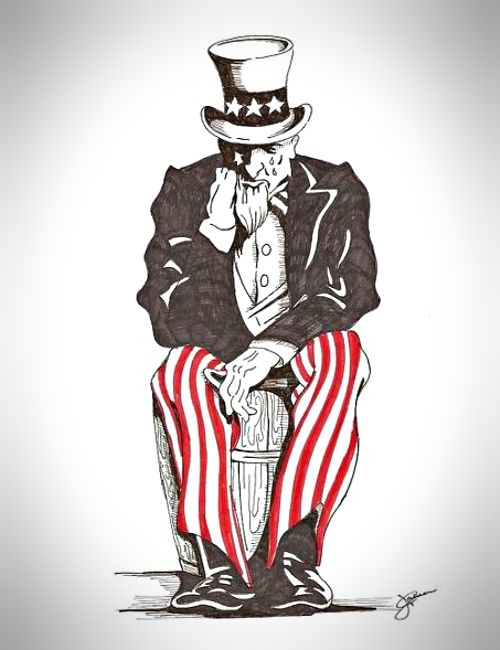
Lady Liberty Weeps

I was going to write about something else this week, but the combination of the initial plans for the Mexico wall and especially the ban on immigration from selected Moslem countries wiped away my other concerns for the moment. I am sure my readers have found plenty of articles to read on both of these topics. But I don’t want to focus on the legality of these measures, or the strategic or diplomatic implications, or the fact that each measure is bad for our country in its own way. All of that is true, but when it comes to immigration, it’s personal for me. To explain why, I want to tell you a story. It may not seem relevant at first, but I will get to that.

I am the grandson of Jewish immigrants to the United States. The only story I know at all well is that of my mother’s father. He came to the United States through Ellis Island as an 11 year old boy in 1911. He made the journey alone, sustained by the dream of being reunited with his older brothers who had preceded him here. He particularly was eager to be reunited with his favorite brother Harry. He and his family were fleeing the pogroms in eastern Europe, so I seriously doubt that his papers were in order, making it unlikely that he could have made it through the screening procedures that were already in place under President Obama. But, in 1911, he was allowed into the country. He grew up to be a gentle and loving man. We never discussed it, but I think he was always grateful to the country that gave him and his family refuge in those dark days. I never heard that he had any interest in relocating to Israel after 1948. He had made a good life here by then. He had learned a trade, in the days when bookbinding was done painstakingly by hand. Years later, when he had been long retired, he rebound a set of Encyclopedia Britanicas that my parents had had for many years. Ironically, the set was from 1911, the year my grandfather came to America.

Now suppose my grandfather had been trying to get to America as someone like Donald Trump took office. He would have been taken off the boat in Europe, and told he was no longer allowed to make the trip. If his brother Harry found out somehow what had happened and came to Europe to try to find him, he might not have been able to return to the United States. All of this would have been justified by a president who believed that notorious anti-Semitic propaganda, such as the Protocols of the Elders of Zion and the Rothschild banking conspiracy were real, and this theoretical president would have had a Steve Bannon figure at his side encouraging this belief. (For the sake of historical accuracy, the Protocols did not have much influence in the United States until they were promoted by Henry Ford in the 1920s, but you get the idea.)

You can tell me if you want to that the Jews and the Moslems in the modern Middle East are enemies, but these are human beings seeking refuge, just like my grandfather. Some of them have actually helped our country fight against terrorism, and it is now no longer safe for them to live in their country of origin as a result. They all have their stories, just like my grandfather, and their hopes and dreams are here. The Mexicans who seek to come here have received less attention this week, but they too are seeking refuge from poverty and crime, not bringing it with them. Donald Trump has obviously never needed to seek refuge from anyone, and he is emotionally incapable of imagining what that would be like. They say all politics is personal, and this certainly is for me.

Woody Guthrie understood that immigration policy affects real people with real lives, so his song Deportee is perfect here: