Showing posts with label Bernie Sanders. Show all posts

Thursday, September 1, 2016

The Lady Doth Protest Too Much

A few days ago, I posted an article on Facebook which raked Jill Stein’s platform over the coals, and demonstrated that her proposals are not based on reality. The author used this to make the case that Stein is completely unsuited to be president. In sharing this, I missed the point, and so did the article. I expected that the article would set off a firestorm of comments, and it did. What I did not expect is that no one really bothered to refute the points the article actually made. Instead of arguing that they believe in Stein, my friends instead began lining up their attacks on Hillary Clinton. Others came to Clinton’s defense, including me, but we did not stress Stein’s faults either. The argument is still raging. In thinking about all this, I realized that Jill Stein’s fitness to be president is beside the point. Almost no one is voting for her to be president. They are voting to express their anger at how the Democratic nominating process was handled. They are expressing their displeasure with Bernie Sanders for wanting to work within the system for change, and surrendering his perceived ideological purity to do so. And most of all, they are voting to express their mistrust of Hillary Clinton.

When you understand this kind of voting, you begin to see it everywhere. The Republican Party establishment had coronated Jeb Bush as their standard bearer before their nominating process ever got going. They knew he was a weak candidate, but they thought that, by flooding the field with Tea Party protest choices, they could get Bush through to the nomination. The field of extremists would cancel each other out, making the size of the field the perfect defense against further encroachment. They did not expect that Donald Trump would quickly master his role as a protest candidate. As with Jill Stein, Trump’s fitness to be president does not matter to his faithful, because they do not expect him to be elected. Instead, he is a figurehead who gives them an avenue to express their anger. The absurd proposals he reiterated this week regarding immigration do not matter, because his followers don’t want real policy proposals from him. They want his anger at trade policies, perceived preferential treatment of minorities, and his disdain for elites like Hillary Clinton and Jeb Bush, who think they know what is best for the people Trump speaks to.

Gary Johnson, the Libertarian Party candidate, has been pushed as a possible counter-protest choice for Republicans who can not bring themselves to support Trump. Johnson and his party stand, more than anything, for severe limits on government. Keep in mind that establishment Republicans like Mitch McConnell have dedicated themselves to the refusal to govern for a Democratic president, and the choice of Johnson as a protest becomes understandable. In some ways, a Republican vote for Johnson is an expression of anger at themselves for failing to control their own party. For a progressive voter, a vote for Johnson is a rejection of our political process. It is an exercise in bomb throwing, saying that the process does not work, and the only way to fix it is to destroy it. Neither a progressive nor a Republican who votes for Johnson is saying anything about whether Johnson is fit to be president.

The most interesting protest candidate to consider in this light is Bernie Sanders. I have no doubt that Sanders began his campaign as a protest. As an avowed socialist who lived most of his life during the Cold War, Sanders must have started with the assumption that he would not win. He also must have known that, as a Jew, he would have to deal with anti-Semitic attacks if he became the nominee. Hillary Clinton would never have stooped so low, but Donald Trump certainly would have, and I am grateful that we never had to find out how well it might have worked. A vote for Sanders then, as he framed it, was a vote for the economically dispossessed who were being ignored by the establishment wing of the Democratic Party. For Sanders, this was always a protest from within, which is why he ran as a Democrat to begin with. Of course we know what happened. Sanders drew far more support than even he expected. His socialism proved not to be an obstacle for far more Americans than he ever dreamed. It was when it started to get real that the Sanders campaign began to slow down. Faced with the possibility that he might actually become the nominee, it suddenly began to matter how he would actually govern, and Sanders got bogged down somewhat in the details. In the end, he came up short of the needed delegates. At that point, he did what he had said he would do from the very beginning. He fought for, and won, concessions to his positions, and then he came out in support of Hillary Clinton. Up to now, his is the only protest candidacy this year that has succeeded on its terms.

Growing up as I did in a family that placed a great importance on politics, I lived through many arguments about the value of protest voting versus supporting an actual potential president. The conclusion that I reached is the one I am sticking to this year. Primaries are the times to support protest candidates, the time to express one’s ideals for what the president should be and do. In the general election, especially one where the differences between the candidates are as stark as they are this year, I vote for the best potential president available. By refusing to opt out of the process by protest voting, I believe I am letting the Democratic Party know that I must be counted, this year and in elections to come, as a likely voter. A Republican who wants to influence his or her party this way can vote for Trump if they believe he represents the direction the Party should go in, or he or she can let the Republican establishment know that things have gotten out of hand by voting for Hillary Clinton. The system we have is not going to be destroyed by the protest votes of perhaps 15% of the electorate, (a generous number). Instead, I believe, these voters are telling the two major parties that they can ignore their votes, and govern only for the ones who actually put and keep them in office. There is nothing ideological pure about this, and I hope for the chance to criticize President Hillary Clinton in this space starting next year. But I will not withhold my vote from her, given everything that is at stake.

Thursday, July 28, 2016

An Open Letter to Bernie or Bust

In this post, I am not going to try to talk you out of it. I have presented elsewhere evidence that Hillary Clinton and Bernie Sanders competed for the Democratic nomination under the same messed up rules, that the voter suppression that occurred was perpetrated by local Republican officials, and made possible by the gutting of the Voting Rights Act by the Republican majority on the Supreme Court. But you don’t want to hear that. In the end, the greatest crime committed by Hillary Clinton is that she fails your test of ideological purity. And she does, I won’t deny it. So you have grandly declared that you will never vote for “that woman”. You will vote for Jill Stein, or Gary Johnson, or you will stay home. I have seen some people say that they would vote for Donald Trump, as an act of revenge on the Democrats; if this is you, I can only say that you never knew what you were doing in supporting Bernie Sanders. Donald Trump represents everything Bernie Sanders opposes, so you could only vote for Trump now if you never really supported Sanders’ policy goals in the first place. This post is for the rest of you, the ones who genuinely care about what Sanders wanted to do.

Tonight, Hillary Clinton will give her acceptance speech. In so doing, she will set the tone for the fall campaign. She will reveal what approach she will take to trying to defeat Donald Trump, and we will understand which potential voters she feels are most important to her chances of victory. That is where you come in. Clinton had to decide which was her priority: reunifying the party by appealing to the supporters of Bernie Sanders, or appealing to the much more conservative swing voters who decide normal elections. This election is not normal in part because of the strength Bernie Sanders showed in bringing so many people together in the cause of economic justice. If we stayed together, there might be enough of us to risk alienating swing voters in order to address our concerns. This would also have a bearing on how Hillary Clinton would govern, because she would want a second term, and in a second term she would want to leave a legacy that the next Democrat could run on. But you have let Hillary Clinton know that these elections will be decided without you. Your vote will not count, or you will not vote at all.

By now, you know that Bernie Sanders does not agree with you. He endorsed Hillary Clinton after gaining as much ground as possible in the negotiations over the Party platform. He demonstrated that he was not attempting some weird trickery to snatch the nomination at the convention, instead calling for Clinton to receive the nomination by acclamation. He made it clear during the primaries that he believes there are important differences between himself and Clinton, but he has made it clear now that he believes supporting Clinton is the path that allows him to do the greatest good.

You have a perfect right to disagree. But remember, you came together in the first place because you believed in Bernie Sanders. If you feel betrayed now, what is your rationale for existing as any kind of movement? My answer is to continue to work for change within the Democratic Party. That does not have to be your answer. But I hope you will learn everything you can about how successful movements for social change have won their victories. I hope you will study the history of how viable third parties have come to be in the history of the United States. And most of all, I hope you will translate everything you learn into concrete, meaningful actions. If you do that, you and I will always be allies, and I will welcome your help. You may not believe that now, but I hope there will a time when victories have been won on both of our paths, and we can get together and thank each other. Until then, go in peace.

Friday, July 15, 2016

Endings and Beginnings

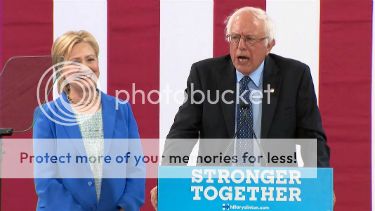
Bernie Sanders, with his endorsement of Hillary Clinton this week, admitted that he will not be the Democratic nominee for president this year. By pledging to work for Hillary Clinton’s victory, he also signaled to his supporters that he does not want to run as a write in or third party candidate. This is a message that some of his most vocal supporters are finding hard to accept. I have been expecting and bracing for this moment for a while now, but I am not going to gloat or say I told you so. I have been where these “Berners” are now, and I feel your pain. It’s just that I went through this a long time ago.

My parents grew up in the Great Depression, when capitalism had failed, and great changes were possible for the liberal cause. Eugene V Debs was a Communist Party candidate who received one million votes in the 1932 election, at a time when that was a much higher percentage of the electorate than it is now. Following that, Communists could and did visit the Roosevelt White House and had a chance to influence the shaping of the New Deal. My parents met because of their activism in the years following World War II, and they were ready to change the world. By the time I came along, the great cause was the protests against the Vietnam War. We were a politically aware family, and the first presidential election I remember was in 1968. I was eight years old, and I understood the election as a simple fight between good and evil, with Eugene McCarthy being the agent of good. Four years later, I could have described in much more detail why George McGovern was the good guy, and Richard Nixon the villain. I also felt McGovern’s landslide defeat much more strongly than I had McCarthy’s loss. By 1984, I was the avid follower of politics that I remain today, and I could tell you in great detail why it would be a disaster if the nation had to endure another four years of Ronald Reagan, but I watched Walter Mondale suffer another landslide defeat. Somewhere in the ashes of these three losses especially, I learned that most American voters do not think like me. By extension, I also learned that a liberal candidate could not become president unless another disaster on the scale of the Great Depression occurred. Barring that, the best outcome would be that we could show enough strength to influence policy.

Bernie Sanders is roughly a generation older than me, and he learned these same lessons. His candidacy this year was that show of strength that I mentioned, and it won him major concessions in the Democratic platform. Despite the noise about her, Hillary Clinton is exactly the kind of candidate who is most likely to be influenced by all of this. She practices the politics of the possible, and Sanders has shown her that more is possible now than she thought. Her incrementalism is a reflection of the fact that American voters fear changes that come too quickly, and that is the simplest explanation of how she beat Sanders for the nomination. But the American people were ready when gay marriage arrived, and Sanders showed that they are ready to build a new set of paradigms regarding the economy.

The most encouraging thing I have seen from Sanders supporters since the endorsement is a discussion of how to use the momentum this campaign has generated. People who were brought together in support of Sanders are talking about staying in touch, and using their numbers to influence elections at state and local levels. They have had their first taste of activism, and at least some want to do more. Bernie Sanders knew when he started this that even the election in November was not the end of the fight. To maintain pressure, the followers he gathered would have to gird themselves for a long siege, and learn to celebrate a series of small victories instead of one large one. There will be those who feel betrayed right now, and will fade away after the election, never to be this involved again. But there are also signs that some will stay around and continue to work for change. They are the ones who will have a chance to show present and future Hillary Clintons what is possible.